Personal memoir
Reflections from a lifelong United Nations expert, from the deep field to the conference room.
The Book
Humanitarian Action, Global Diplomacy, and the Challenges of Reform
Overview
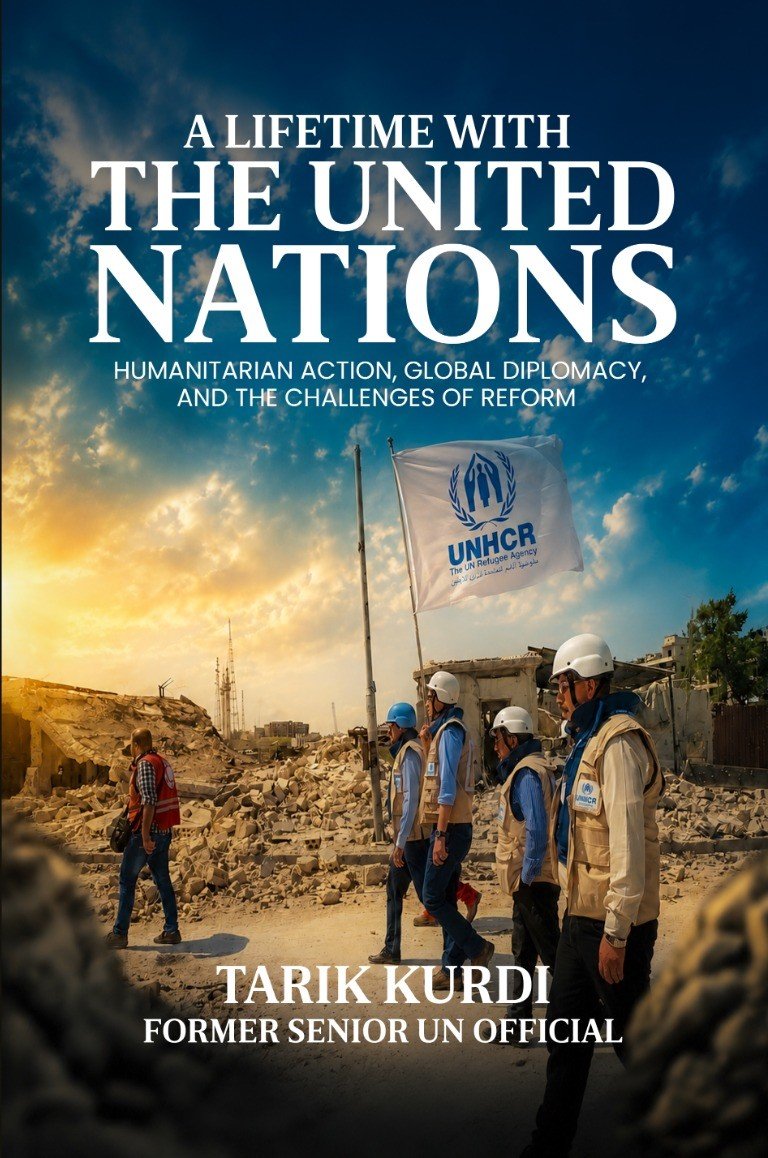
A Lifetime with the United Nations draws on experience gained across more than fifteen countries and some of the world’s most challenging humanitarian crises and complex diplomatic environments. It offers a rare insider’s perspective on the achievements, limitations and future of the United Nations.
Combining personal reflection with historical analysis and policy insight, the book explores humanitarian action, international diplomacy, human rights, peace and security, sustainable development, and the ongoing debate surrounding United Nations reform. Written in an accessible yet authoritative style, it provides readers with a deeper understanding of how the Organization operates — and why effective multilateral cooperation remains essential in addressing the challenges of the twenty-first century.
It is at once a professional memoir and a thoughtful reflection on the future of global governance — neither idealising nor dismissing the United Nations, but offering an honest assessment based on lived experience.
What the Book Explores
Reflections from a lifelong United Nations expert, from the deep field to the conference room.
The origins of modern multilateralism, the lessons of the League of Nations, and the founding of the UN.
Life-saving assistance and protection in Afghanistan, Iraq, Syria, Sudan, Somalia and beyond.
How Member States address global challenges through negotiation, cooperation and international law.
The instruments and mechanisms that promote and protect human rights across the system.
Development cooperation and the 2030 Agenda for Sustainable Development.
The collective security model, the Security Council and the constraints upon decisive action.
The case for continuous adaptation — of the Council, of financing, and of coordination.
The Structure
The book unfolds as a sequence of thematic chapters — from the first experiment in collective security to the reforms that will define the Organization’s future.
The first experiment in collective security, its ambitions, its structural weaknesses, and the lessons it bequeathed.
The historical moment of 1945, the Charter, membership, purposes and the principal organs of the Organization.
The Organization’s most representative body — its roles, resolutions and system of voting.
Composition, the veto power, the Responsibility to Protect, enforcement measures and the case for comprehensive reform.
The principal judicial organ, questions of compliance and enforcement, and the ad-hoc tribunals of the modern era.
Coordination of the Organization’s economic, social and development work across the system.
The international civil service, its departments and offices, and the office of the Secretary-General since 1945.
Inter-agency coordination mechanisms and the International Civil Service Commission that bind the system together.
International humanitarian law and the International Criminal Court within the wider legal architecture.
The Universal Declaration, the core treaties, the Human Rights Council and the Office of the High Commissioner.
UNHCR, UNICEF, WFP, WHO, FAO and UNRWA — and field operations in Afghanistan, Iraq, Syria, Sudan and beyond.
UNDP, UNV, UNEP, UNFPA and UNOPS, and the structural constraints that shape their work.
From the ILO and UNESCO to the World Bank Group and IOM — the specialized institutions of the wider UN family.
Sustainable development, the Sustainable Development Goals, and the framework for follow-up and review.
The system under strain — financing, coordination and the reforms required to strengthen multilateralism.
Key Messages
Who it is for
Why it matters
Few books offer a perspective that combines field-level humanitarian experience, headquarters-level institutional understanding, and reflection on the broader evolution of the United Nations system.
Its value lies in that combination: first-hand operational experience, institutional knowledge accumulated over decades, historical and policy analysis, practical insight into humanitarian action, and constructive recommendations for reform.
Ebook, paperback and hardcover editions will be available. Purchase links will be added as soon as they are released.
View the editions